
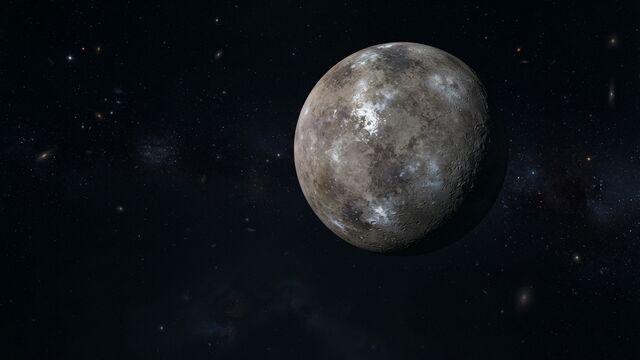
Space - Ceres: dwarf world of rock and ice
Space · 0:38 · Ceres ·
Measuring roughly 590 miles across, Ceres is the largest object orbiting within the asteroid belt. First identified in 1801, its spherical shape points to a layered interior like Earth, likely featuring a rocky core, an icy mantle, and a thin crust. Hubble Space Telescope observations reveal distinct light and dark patches, possibly ancient impact scars. Rotating once every nine hours, this miniature world offers researchers rare clues about planetary formation.
Source: ESA/Hubble
More videos
- Space - Saturn’s moons race across its edge-on rings 0:38
- Space - Mystic Mountain: Carina’s crumbling three-light-year tower 0:41
- Space - NGC 6822: the galactic neighbour that redefined the universe 0:43
- Space - NGC 2005: the stellar relic of a vanished galaxy 0:41
- Space - Asteroid Vesta: Hubble reveals signs of a massive collision 0:38
- Space - Jupiter’s Great Red Spot: a centuries-old anticyclone storm 0:40
- Space - Io’s hidden frost revealed through ultraviolet observations 0:42
- Space - Pismis 24-1: a heavyweight star split in two 0:42
- Space - The Einstein Cross: a cosmic mirage confirmed by Hubble 0:45
- Space - Messier 77: a spiral galaxy powered by a black hole 0:41
- Space - Saturn's aurorae: glowing ultraviolet lights at the poles 0:42
- Space - NGC 6072: a dying star's complex cosmic disc 0:48