
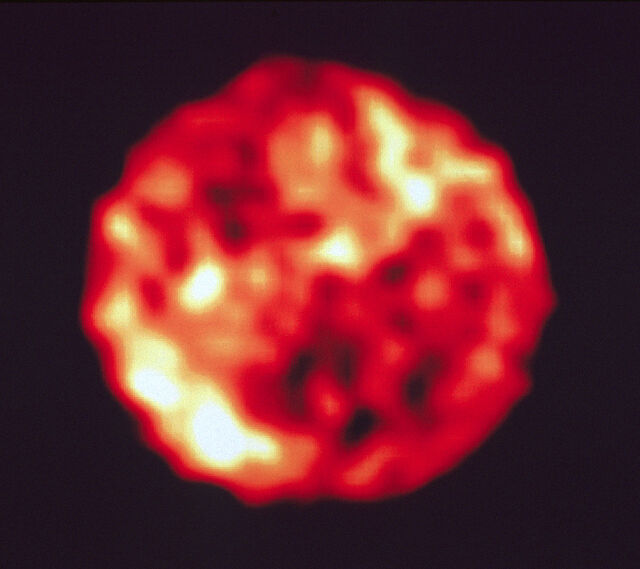
Space - Io’s hidden frost revealed through ultraviolet observations
Space · 0:42 · Planetary Science ·
When viewed in ultraviolet light by the Hubble Space Telescope, Jupiter's volcanic moon Io presents a surprising appearance. Regions that look bright in visible light turn dark in the ultraviolet spectrum. Astronomers explain that large portions of Io’s surface are coated with sulfur dioxide frost, a chemical compound that strongly absorbs ultraviolet radiation. Despite being four hundred fourteen million miles from Earth and no larger than Earth's moon, Hubble resolved surface features as small as one hundred fifty miles across on this geologically active world.
Source: ESA/Hubble
More videos
- Space - Asteroid Vesta: Hubble reveals signs of a massive collision 0:38
- Space - Jupiter’s Great Red Spot: a centuries-old anticyclone storm 0:40
- Space - Pismis 24-1: a heavyweight star split in two 0:42
- Space - The Einstein Cross: a cosmic mirage confirmed by Hubble 0:45
- Space - Messier 77: a spiral galaxy powered by a black hole 0:41
- Space - Saturn's aurorae: glowing ultraviolet lights at the poles 0:42
- Space - NGC 6072: a dying star's complex cosmic disc 0:48
- Space - The Crab Nebula: Webb reveals intricate supernova remnants 0:41
- Space - Hen 2-437: icy blue wings of a dying star 0:42
- Space - Kleinmann-Low Nebula: finding a runaway star in Orion 0:41
- Space - NGC 7496: cosmic bubbles carved by newborn stars 0:41
- Space - Southern Crab Nebula: an hourglass nestled within an hourglass 0:46