
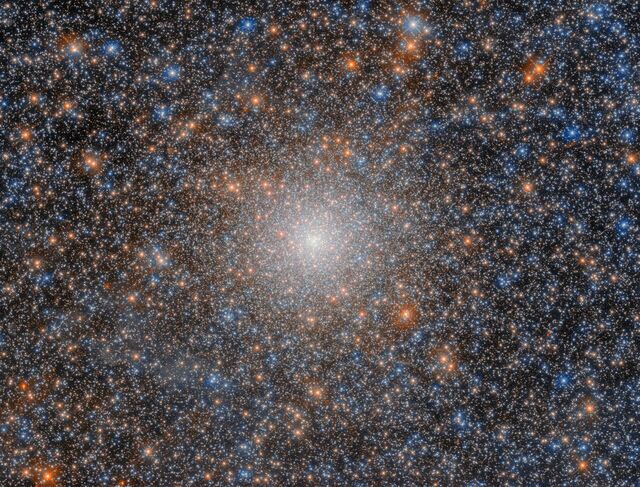
Space - NGC 2005: the stellar relic of a vanished galaxy
Space · 0:41 · Astronomy ·
Tightly bound globular clusters can endure for billions of years, acting like ancient cosmic fossils. NGC 2005, positioned near the heart of the Large Magellanic Cloud roughly 162,000 light-years away, carries a striking secret. Its stars hold a chemical recipe completely distinct from the stars surrounding it. Astronomers say this difference provides tangible evidence of galaxy evolution: NGC 2005 is the surviving core of an ancient smaller galaxy consumed by the Large Magellanic Cloud long ago.
Source: ESA/Hubble
More videos
- Space - Ceres: dwarf world of rock and ice 0:38
- Space - Saturn’s moons race across its edge-on rings 0:38
- Space - Mystic Mountain: Carina’s crumbling three-light-year tower 0:41
- Space - NGC 6822: the galactic neighbour that redefined the universe 0:43
- Space - Asteroid Vesta: Hubble reveals signs of a massive collision 0:38
- Space - Jupiter’s Great Red Spot: a centuries-old anticyclone storm 0:40
- Space - Io’s hidden frost revealed through ultraviolet observations 0:42
- Space - Pismis 24-1: a heavyweight star split in two 0:42
- Space - The Einstein Cross: a cosmic mirage confirmed by Hubble 0:45
- Space - Messier 77: a spiral galaxy powered by a black hole 0:41
- Space - Saturn's aurorae: glowing ultraviolet lights at the poles 0:42
- Space - NGC 6072: a dying star's complex cosmic disc 0:48