
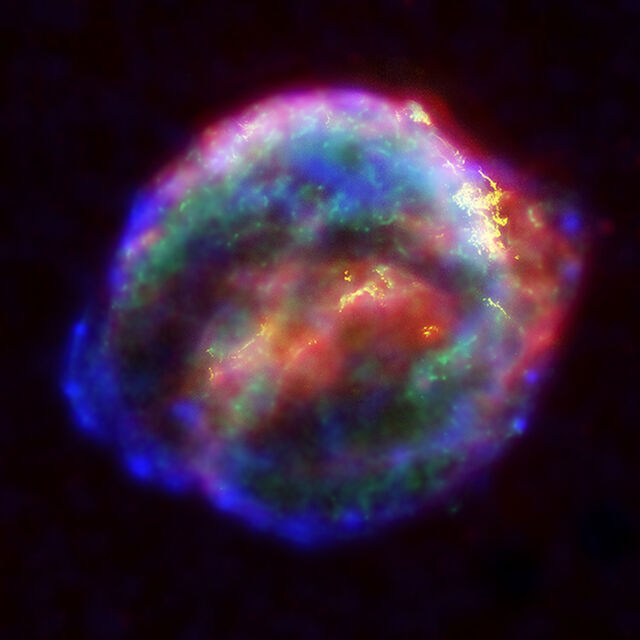
Astronomy - Kepler's Supernova: the Milky Way's last naked-eye blast
Astronomy · 0:37 · Astronomy ·
In October 1604, a stellar explosion known as Kepler's Supernova flared up in the constellation Ophiuchus. Classified as a Type Ia supernova, it occurred no farther than twenty thousand light-years from Earth. Described by German astronomer Johannes Kepler in his work De Stella Nova, it holds a unique place in modern observing history. It remains the most recent supernova inside the Milky Way galaxy that human observers have unquestionably witnessed using only the naked eye.
Source: Wikipedia
More videos
- Astronomy - IC 443: the Jellyfish Nebula's cosmic collision 0:49
- Astronomy - Tidal shocks: how cosmic encounters reshape star clusters 0:40
- Astronomy - Mayall II: Andromeda's colossal remnant cluster 0:40
- Astronomy - Uhuru: opening the high-energy X-ray sky 0:40
- Astronomy - CoRoT: pioneering the search for rocky worlds 0:42
- Astronomy - Black Eye Galaxy: A spiral with counter-rotating disks 0:37
- Astronomy - Messier 59: An elliptical galaxy hiding inner secrets 0:40
- Astronomy - LMC N49: The explosive Brasil Nebula 0:42
- Astronomy - Messier 62: The dense flickering cluster in Ophiuchus 0:38
- Astronomy - NGC 6781: The floating cosmic snowglobe 0:40
- Astronomy - Lost comets: Chasing wanderers that vanish from view 0:40
- Astronomy - Helix Nebula: A close planetary neighbor in Aquarius 0:39