
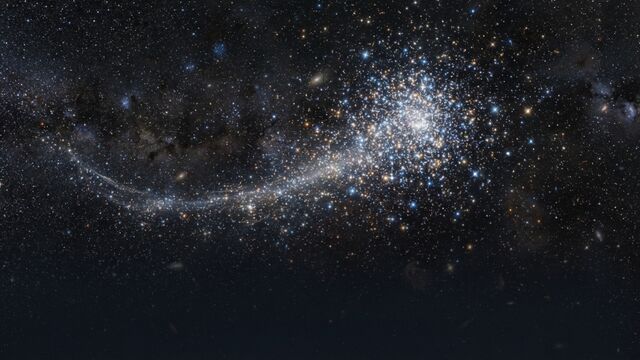
Astronomy - Tidal shocks: how cosmic encounters reshape star clusters
Astronomy · 0:40 · Star clusters ·
When a star cluster sweeps past a massive body, like an interstellar cloud or the Milky Way's galactic plane, it experiences a gravitational perturbation called a tidal shock. This sudden interaction injects dynamic energy into the cluster, heating it up and driving its expansion. Outer stars are torn away in the process, limiting the impact of future encounters. These shed stars can stretch across space into lengthy tidal tails, providing astronomers with luminous trails that trace the orbital path of the cluster.
Source: Wikipedia
More videos
- Astronomy - IC 443: the Jellyfish Nebula's cosmic collision 0:49
- Astronomy - Kepler's Supernova: the Milky Way's last naked-eye blast 0:37
- Astronomy - Mayall II: Andromeda's colossal remnant cluster 0:40
- Astronomy - Uhuru: opening the high-energy X-ray sky 0:40
- Astronomy - CoRoT: pioneering the search for rocky worlds 0:42
- Astronomy - Black Eye Galaxy: A spiral with counter-rotating disks 0:37
- Astronomy - Messier 59: An elliptical galaxy hiding inner secrets 0:40
- Astronomy - LMC N49: The explosive Brasil Nebula 0:42
- Astronomy - Messier 62: The dense flickering cluster in Ophiuchus 0:38
- Astronomy - NGC 6781: The floating cosmic snowglobe 0:40
- Astronomy - Lost comets: Chasing wanderers that vanish from view 0:40
- Astronomy - Helix Nebula: A close planetary neighbor in Aquarius 0:39