
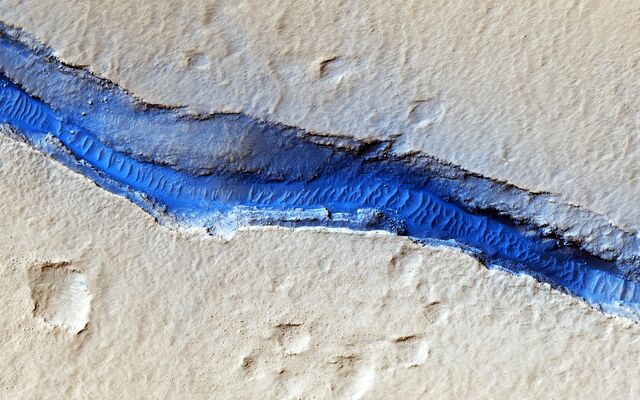
Planet Earth - Cerberus Fossae: The Frozen River of Martian Sand
Planet Earth · 0:37 · Mars ·
Cutting across the dusty plains of Mars, the fissures of Cerberus Fossae create the striking optical illusion of a flowing river. Formed by volcanic and tectonic forces, these deep trenches trap dark basaltic sand blown by Martian winds. In infrared views, the sand appears deep blue against pale surrounding dust, arranged in ripple-like ridges. Despite resembling water, this river of sand is completely frozen in place, with spacecraft monitoring showing no movement or migration of the ripples over time.
Source: NASA
More videos
- Planet Earth - Daedalia Planum: The Colossal Lava Fields of Mars 0:43
- Planet Earth - ECOSTRESS: Mapping Earth's Extreme Heat From Space 0:35
- Planet Earth - Mount Nemrut: Turkey's Sleeping Giant Above Lake Van 0:38
- Planet Earth - Io: Giant Volcanic Plumes on Jupiter's Moon 0:42
- Planet Earth - Malaspina Glacier: Alaska's Fragile Ice Shield 0:34
- Planet Earth - Puyehue-Cordón Caulle: orbital views of an Andean eruption 0:44
- Planet Earth - San Cristóbal and Masaya: multi-angle 3D views of Nicaragua 0:44
- Planet Earth - Mount Etna: mapping Sicily's restless giant with space radar 0:38
- Planet Earth - Coalition for Rainforest Nations: using markets to protect tropical forests 0:48
- Planet Earth - Eyjafjallajökull: how lava carved through Iceland's icecap 0:44
- Planet Earth - Colombia's hidden volcano: radar reveals a dormant Andean summit 0:40
- Planet Earth - Kilauea: orbital views of volcanic plumes and toxic fog 0:41